
Home / Sectors / In-Flight Supplies
Airline catering · in-flight services · airside supply
Security Screening For In-Flight Supplies And Airline Catering
Meals, bar carts, blankets, headsets, amenity kits and duty-free stock all reach the aircraft the same way: packed into trolleys, sealed, driven airside and loaded. That makes the in-flight supply chain a route onto an aircraft that never passes a passenger checkpoint — and screening it is now a serious equipment question for every caterer and in-flight services provider.
Start here
What You're Actually Trying To Stop
The threat in an in-flight services operation is not a passenger with a bag. It is an item placed into a trolley, a box or a cart somewhere between production and the aircraft door.
- Prohibited articles concealed in supplies — weapons, explosives and IED components hidden in dense, cluttered loads that look entirely normal from the outside.
- Insider risk — production, packing, wash-up and loading involve a lot of people, agency staff and vehicle movements, across shifts that run through the night.
- Tampering in transit — the run from the production unit to the airside gate, where a seal is the only thing between your control and the aircraft.
- Time — flights depart to a schedule and chilled goods have a clock of their own. Screening that cannot keep up with the loading plan will be worked around, and a control that gets worked around is not a control.
Our recommendation
What We Supply For In-Flight Services
Four layers, specified around your building and your loading plan rather than a brochure.
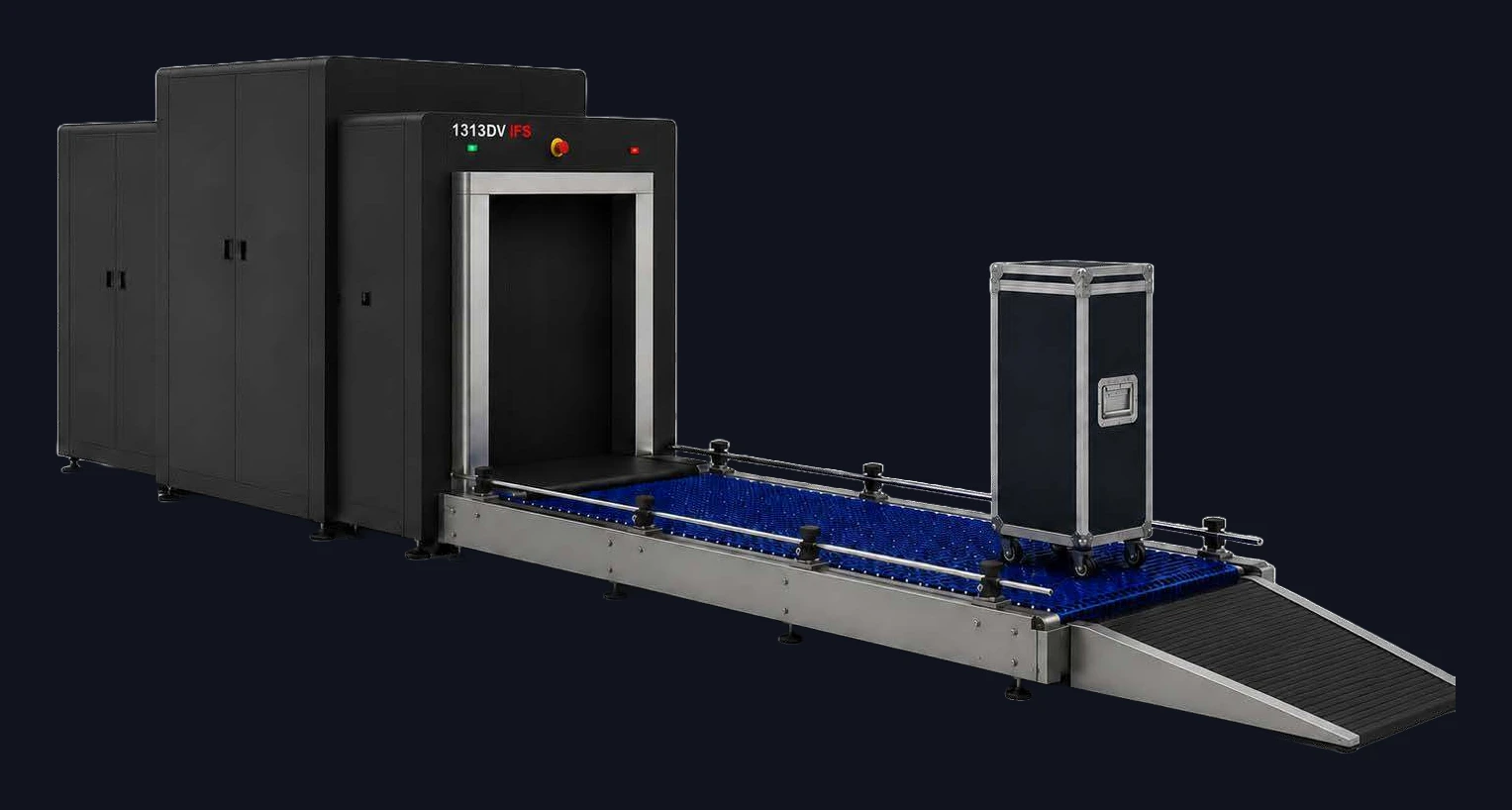
HS 1313 DV IFS Trolley Scanner
Purpose-built for aviation catering rather than a cargo machine pressed into service. Dual 200 kV generators and dual-view imaging see into a densely packed cart; the 1305 × 1310 mm tunnel takes a full-height trolley; the integrated Trolley Flow System conveyor sits at 300–350 mm so trolleys roll on from floor level up a ramp. Conveyor load to 330 kg, belt speed >0.22 m/s, and the conveyor geometry — length, bends, transfer points — is engineered around your footprint.
Conveyor X-ray For Boxes And Stores
Not everything travels in a trolley. Cartons, amenity kits, duty-free stock, headsets and dry stores go through checkpoint and hold-baggage machines: HS 6040 (610 × 410 mm) for boxes and bags, HS 8065 (810 × 660 mm) for larger cases and stillages, HS 1010 (1010 × 1005 mm) for oversize, and the HS 1818 DV at 1810 × 1820 mm where whole pallets need to go through.
Staff Screening At The Boundary
The secure production area is only as good as its entrance. Garrett Paragon walk-through detection with zone indication for the staff entrance, plus handheld metal detectors for secondary search and for spot checks at loading — the kit that gets used most and costs least.
Explosives Trace Detection
Where an image alone is not enough — sealed stores, catering supplies, mail into the unit or a targeted check on a load — Smiths Detection IONSCAN trace detection identifies explosives and narcotics residue in seconds. We are an authorised reseller and service the instruments ourselves, including calibration and consumables.
The compliance picture
Regulated Supplier, In Plain English
A company supplying goods for use on board an aircraft can hold regulated supplier of in-flight supplies status, and that status carries real obligations: a named person responsible for security, aviation security training for everyone with access to supplies, controlled and supervised premises, tamper-evident seals, protected vehicles, and assurance that no prohibited articles are concealed in the supplies. Listings run for up to five years and are inspected.
Screening is how that last point stops being a promise and starts being evidence. Where the chain of custody cannot be guaranteed — a new site, a third-party packer, an unsealed delivery, an airline or airport that sets a higher bar than the minimum — X-ray is the practical answer, because you cannot hand-search a loaded trolley inside a loading window.
We are equipment specialists, not your regulator: your obligations come from the CAA, the DfT, your airline customers and the airports you serve. What we do is make sure the kit you install actually satisfies them, is commissioned properly, and keeps running.
What we bring to a compliance conversation
- Specification against the load — we survey the trolleys, the boxes, the footprint and the throughput before quoting.
- Installation and commissioning — including IRR17 radiation compliance, registration guidance and the survey paperwork your file needs.
- Operator training — equipment training on the system, and accredited X-ray screener and search training through our partners.
- Maintenance that matches the operation — including out-of-hours cover, because catering units run when the flights do.
Just as important
What You Probably Don't Need
In practice
How It Runs Day To Day
Built around the trolley flow
Conveyor length, orientation, bends and transfer points designed to your building, so screened and unscreened stock stay separated and nothing doubles back through the room.
Sized for the peak, not the average
Loading is not evenly spread across a day. We specify for the bank of departures that matters, so screening never becomes the reason a truck leaves late.
Supported around the schedule
Planned maintenance out of hours, parts on the shelf and engineers who install these systems themselves — because a stopped lane in a catering unit stops aircraft loading, not just a queue.
We also supply in-flight services operations through hire, so you can screen to a new requirement or cover a peak season before committing to a capital purchase.
Why RedteQ
Aviation Experience, Without The Aviation Runaround
We work across UK airports and aviation training, we install cargo X-ray at Heathrow-area facilities, and we supply and maintain screening equipment for operators who cannot afford downtime. That is the same discipline an in-flight services facility needs: specify honestly, install cleanly, train the people who will use it, and answer the phone when it matters.
We are independent and multi-brand, so the recommendation is built around your building rather than around one manufacturer's catalogue — and we can support what you already own alongside anything new.
Screening An In-Flight Services Operation?
Tell us what goes on the aircraft, what it travels in and where the building is tight. We will survey it and specify against the flow.
Ask RedteQ Call 0800 161 5512