
Home / Sectors / Cruise Lines & Terminals
Cruise ships · terminals · ports
Screening For Cruise Lines And Terminals
Every passenger and every bag is screened boarding at the terminal, then again each time they re-board in port. Sailing times don't move for a broken machine, so equipment has to work on the day. RedteQ engineers fly to vessels from Malta to Miami, Southampton to Puerto Rico and Germany to Canada — because a machine down in port is not a problem you can book in for next Tuesday.
Start here
What You're Actually Trying To Stop
Maritime screening has the same threat picture as aviation but a harder operational one: confined spaces, salt air, a mixed-age multi-brand fleet, and a turnaround clock that does not move.
- Weapons and prohibited items — embarkation screening of passengers, crew and stores, to the operator's own regime.
- Contraband and drugs — crew screening and stores, where trace detection does what an image cannot.
- Equipment failure in port — the real operational risk: no screening means no embarkation, and the schedule does not care why.
- Multi-brand fleets — vessels refitted over decades carry equipment from several manufacturers, often out of support.
Our recommendation
What We Supply And Support, Ship And Shore
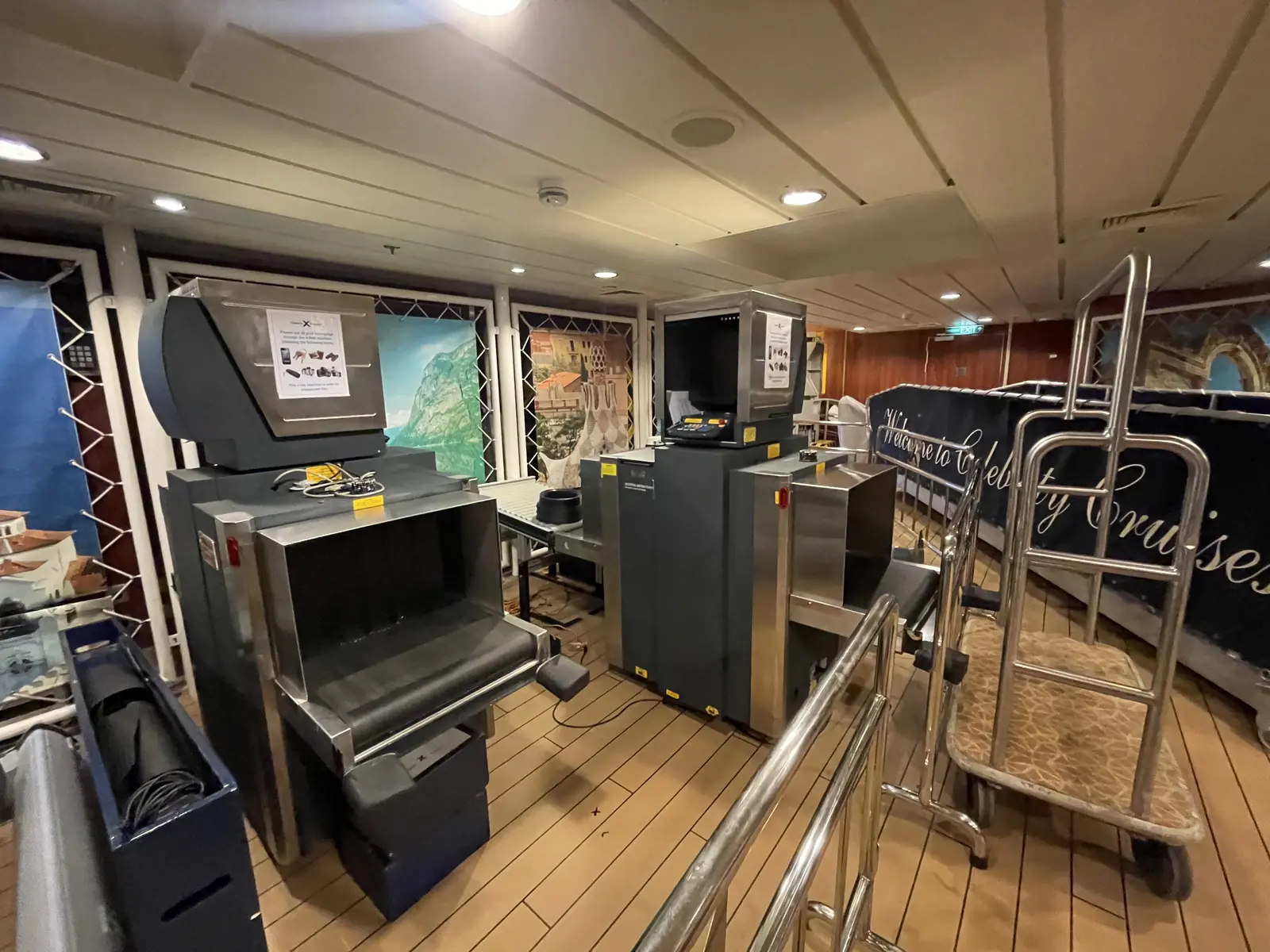
Shipboard installations are constrained by door widths, deck loadings and lift access before they are constrained by anything else. Terminals have the opposite problem: plenty of room, but every passenger for a 5,000-berth ship arriving inside one afternoon. Both start with a survey before we quote.
Compact X-ray For The Ship
Machines specified to fit the vessel, not the brochure: compact units that pass through shipboard doors and lifts, and survive salt air and constant movement.
Terminal Halls & Embarkation
Full checkpoint lanes for the shoreside terminal, sized for an embarkation peak rather than an average day: 6040 and 8065 systems, roller tables and archways at the door, with hire units to add lanes for peak season or cover a refit.
Garrett Paragon Archways
Networkable walk-through detection for embarkation, with zone indication and live statistics — and Quick-Q to keep a boarding queue moving.
AI On Every Lane
Outside aviation we recommend AI detection on every X-ray, and cruise is a clear case: consistent detection through a full embarkation day, whoever is at the monitor.
Just as important
What You Probably Don't Need
In practice
How It Runs Day To Day
Planned around the itinerary
We meet the ship where she will be, not where she was — flights and parts booked against the schedule rather than the diary.
Parts carried, not ordered
Anticipated and brought with us, because there is no spares supplier for X-ray parts on a foreign dockside.
Verified before we leave
Image quality and safety checks completed and documented, so the checkpoint sails ready rather than hopeful.
Terminals run on the same contract as the fleet: planned maintenance between calls, and cover on the day when an embarkation lane goes down.
Proof
Malta To Miami, Southampton To Puerto Rico
Cruise lines increasingly call a genuinely multi-brand company rather than three specialists. Our engineers travel globally to service and repair even the most complex systems, inside turnaround windows that do not move.
Your Fleet, Wherever It Is
Tell us the vessels, the equipment aboard and the itinerary. We will plan the attendance around the ship.
Ask RedteQ Other sectors