
Home / Sectors / Critical Infrastructure
Utilities · energy · ports · government estates
Screening For Critical Infrastructure
Sites that cannot stop, spread across geography, with a constant flow of contractors rather than public visitors. The screening challenge is rarely one gate — it is consistency across many, often where there is no building to put a checkpoint in.
Start here
What You're Actually Trying To Stop
Critical national infrastructure screening is usually driven by regulation, insurance or a specific assessed threat, and the population is contractors and staff rather than the public.
- Weapons and devices at the perimeter — the assessed threat, and the reason the regime exists.
- Prohibited items and tooling — cameras, phones and equipment entering restricted areas where policy forbids them.
- Theft of plant and materials — copper, tooling and equipment leaving, which is a screening problem as much as a CCTV one.
- Inconsistency between sites — the same operator running different regimes at different gates is the vulnerability nobody writes down.
Our recommendation
What We Build For Infrastructure Sites
Rugged, relocatable and consistent — because the estate is rarely one site and never a lobby.
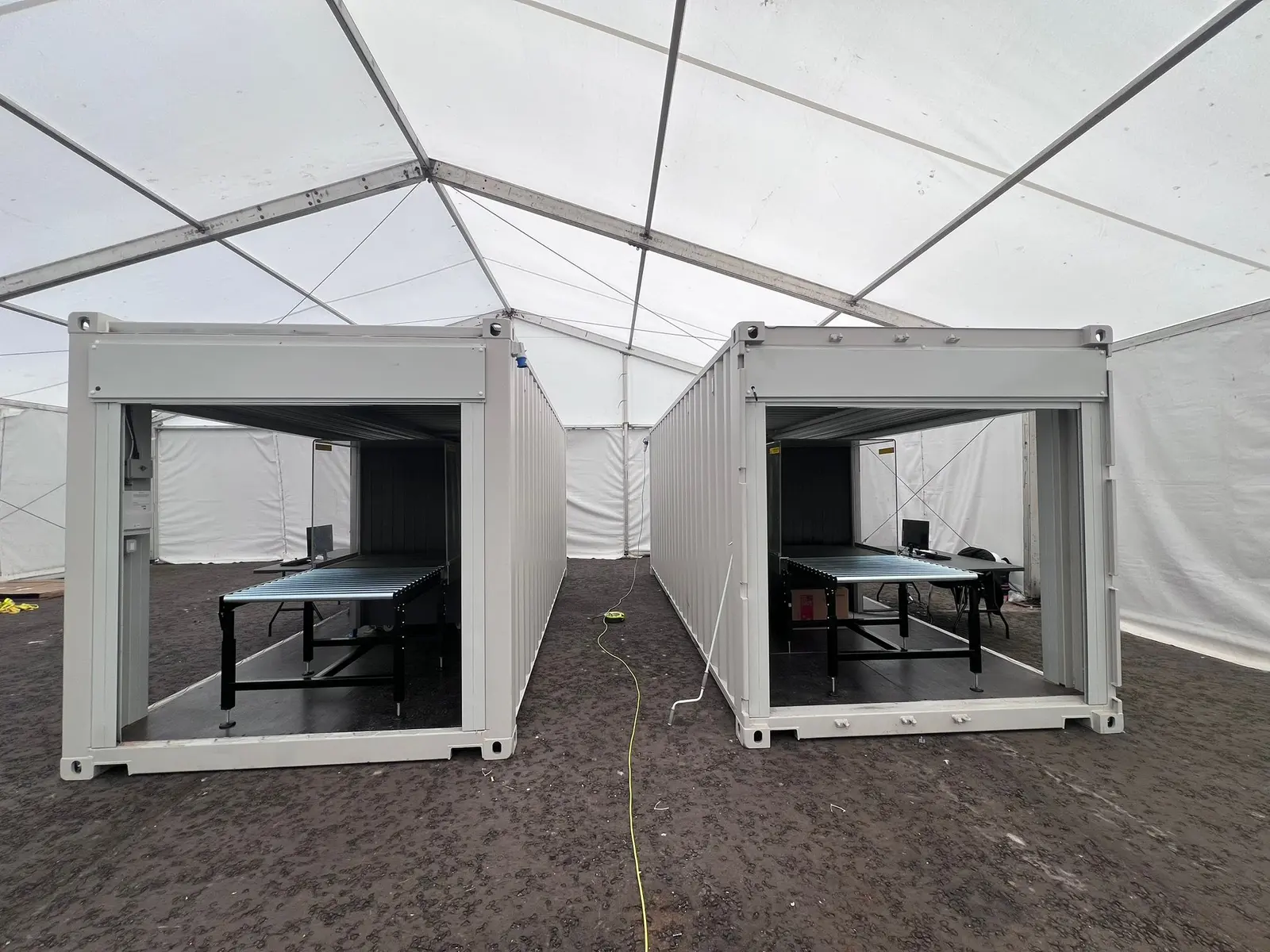
Containerised Checkpoints
A complete screening point built into a container, delivered and craned into position. Screening where no suitable building exists.
Perimeter & Distance Screening
Passive terahertz body scanning detects concealed items on people at up to seven metres, screening several at once as they approach.
Fixed & Portable Detection
Archways, handhelds and rapidly deployable concealed item detection, standardised across sites so every gate runs the same regime.
Just as important
What You Probably Don't Need
In practice
How It Runs Day To Day
Surveyed site by site
Each gate assessed for flow, power, weather and access, then specified against one consistent standard rather than one identical shopping list.
Installed anywhere
Containerised, temporary or permanent, by engineers who are forklift trained and used to sites without loading bays.
Maintained nationwide
Multi-brand service across a distributed estate, with parts on the shelf and a hire fleet when a system has to come out.
Any X-ray we supply outside aviation is specified with AI detection as standard — it gives a consistent detection baseline at a gate that may be staffed by a security officer rather than a trained screener. Our engineers work across airports, government estates and secure sites, and hold the vetting that access requires.
Proof
Screening Where There Was No Building
Containerised checkpoints and bespoke builds: when nothing off the shelf fits the problem, we engineer it. Our custom work spans port operations, temporary terminals and permanent infrastructure sites.
One Standard, Every Gate
Tell us how many sites, how many people and what your assessed threat is. We'll design a regime that is consistent without being wasteful.
Ask RedteQ Other sectors