
Home / Case Studies / Championship Golf
Smart hire · AI-assisted screening
One Operator, Multiple Lanes
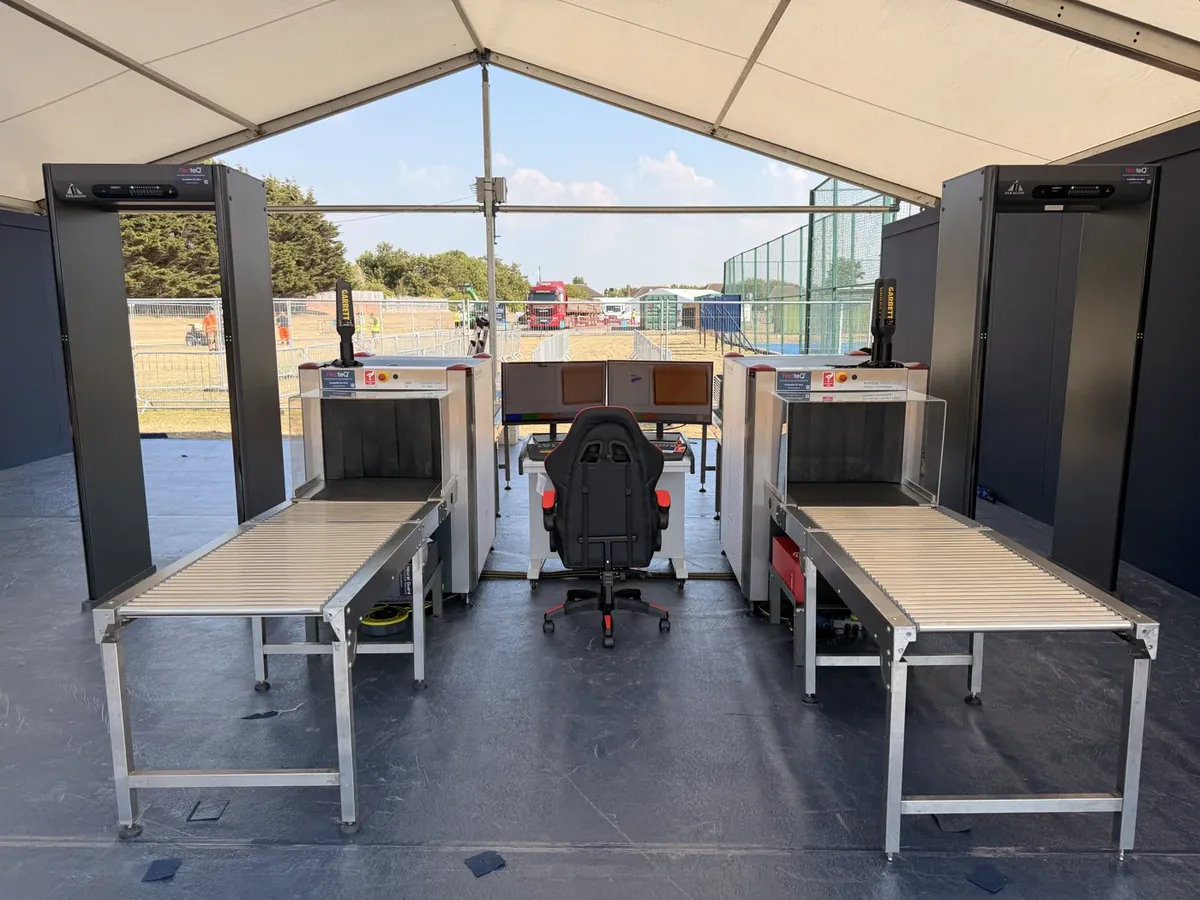
At a championship golf tournament, RedteQ ran AI-assisted bag screening where a single operator oversaw multiple X-ray lanes — and the whole checkpoint could be watched from anywhere. It is the clearest demonstration we have of what automated detection changes about an event checkpoint.
The Problem Isn't Only The Wage Bill
Every event organiser knows screening staff cost money. Fewer say the harder part out loud: qualified screeners are genuinely difficult to find. The events industry competes for a small pool of trained people across a season that peaks for everyone at once, and a checkpoint is only ever as good as whoever happens to be sitting at the monitor at four o'clock on day three.
That is the real argument for artificial intelligence at an event checkpoint. It isn't only that it saves headcount. It's that it takes the most demanding, most fatigue-sensitive job on the checkpoint — reading the image — and gives it to something that performs identically at hour one and hour eleven.
The AI Sets The Baseline, and Holds It
A trained screener is excellent and irreplaceable at judgement, resolution and dealing with people. What no human does is stare at an X-ray image for a full shift without their detection rate moving. Attention drifts, shifts end, and people need breaks, meals and the toilet — as they should.
The AI doesn't. It applies the same detection standard to the first bag of the morning and the last bag of the night, which means the baseline is set and it stays set. That changes what the human is for: the operator manages flow, handles exceptions and talks to visitors, while the software does the relentless part.
The practical consequence at this event was straightforward. One person, with minimal training, oversaw multiple systems at a high standard of detection — because the specialist skill had moved into the software.
Fast Lanes and Accurate Detection, Together
Speed and detection usually pull against each other. Pairing AI X-ray screening with Garrett Quick-Q on the walk-through side is how you get both at once: Quick-Q's dual-panel discrimination means visitors keep phones and small metal items in their pockets rather than divesting them, so the people-flow stays quick, while the AI holds the bag-screening standard behind it.
Risk drops as well as time. When the system flags an item of interest it stops the belt automatically and highlights exactly what it has found, so a bag can't travel past the operator while their attention is elsewhere. The decision still belongs to a person; the catch doesn't depend on one.
Watched From Anywhere
Because the systems report back over the network, the images and events can be observed remotely — a control room, a site security office, a supervisor's tablet on the other side of the venue.
The honest illustration is our own Managing Director, at home on the sofa with the golf on the television and an iPad in his hand, watching the screening images come through from the checkpoint. Not a stunt — the point is that oversight no longer requires standing behind the operator's chair, and that a second pair of expert eyes is available to any event without a second pair of expert feet on site.
What It Proves
- Recruitment pressure eases: fewer specialist screeners needed for the same standard of detection
- The standard doesn't drift: no breaks, no fatigue, no end-of-shift dip in the detection baseline
- Minimal training goes further: one operator, multiple systems, high detection accuracy
- Throughput stays fast: Quick-Q on the archways, AI on the bags
- Risk is engineered down: automatic belt stop with the item of interest highlighted
- Oversight travels: live images viewable remotely, by whoever needs to see them